
Polymorphism Explained
Polymorphism means “many forms.” In programming, it allows the same method name or interface to produce different behaviors depending on the object that uses it.

It helps us write flexible, reusable, and extensible code—where the general structure stays the same, but the specific behavior is decided either at compile-time or runtime.

In short: You can call the same method on different objects, and each object decides what to do in its own way.
Real-World Analogy
Think of the word “play.”
A musician plays an instrument.
A child plays with toys.
An athlete plays football.
The word “play” is the same, but its meaning changes depending on the context.
That’s polymorphism—the same action name triggers different results depending on who’s performing it.
Why Polymorphism Matters
Loose Coupling → You work with general types (interfaces or base classes) instead of specific classes.
Flexibility → You can add new behaviors without rewriting old code.
Scalability → Your system can grow to handle new cases smoothly.
Extensibility → You can “plug in” new implementations without touching the core logic.
Types of Polymorphism
1. Compile-Time Polymorphism (Static Binding)
This happens when multiple methods share the same name but differ in their parameters (number, type, or order). The compiler decides which one to use.
Example – Shape Area Calculator:

When you call area(), the compiler picks the correct version based on the arguments provided.
2. Runtime Polymorphism (Dynamic Binding)
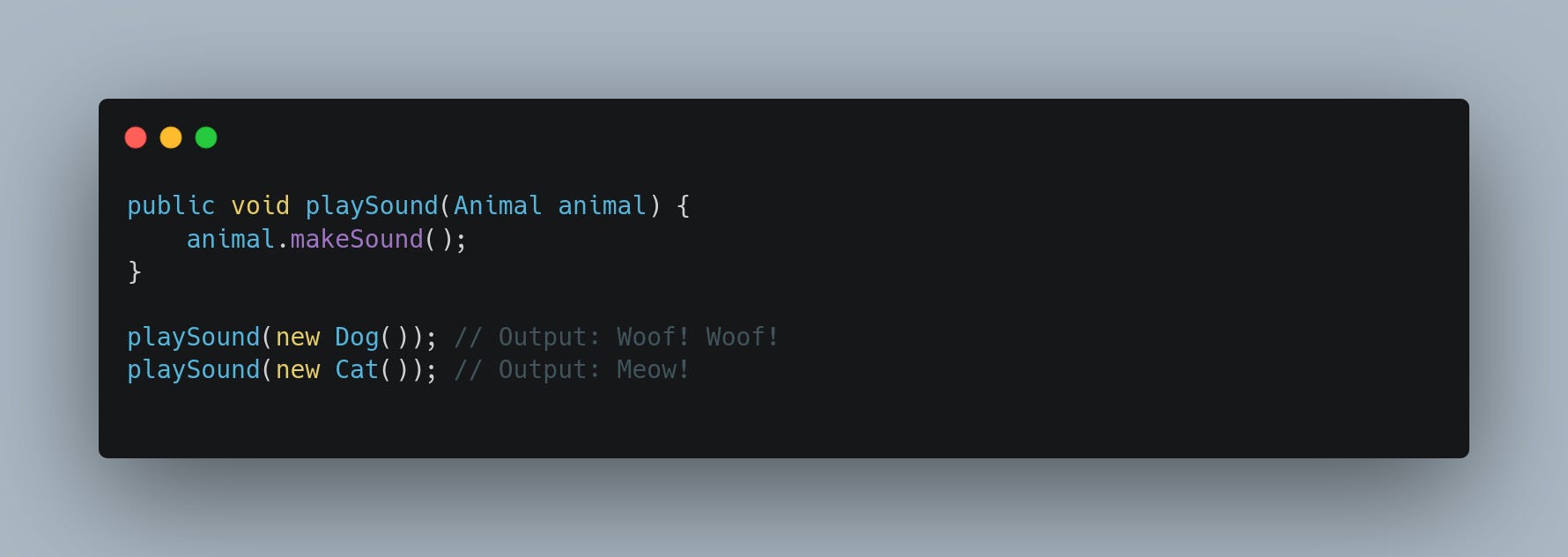
This occurs when a subclass overrides a method from its parent class or interface. The decision of which method to run happens at runtime, based on the object’s actual type.
Example – Animal Sounds:

Usage:
Polymorphism in System Design
In Low-Level Design, polymorphism is useful when you need to support multiple behaviors without changing your main logic. Remember Interface enable Polymorphism
Example – Payment Processing System:

Usage:

Example Usage

Keep grinding and See you in the next one